
The Breakthrough Cone TLUD Design That Delivers More Biochar and Less Smoke from Coffee Husk
Fan-Assisted Standard TLUD vs Fan-Assisted Cone TLUD
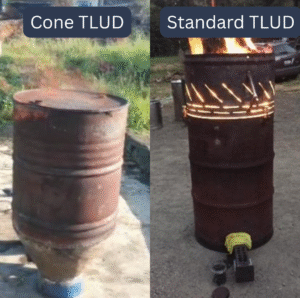
Two fan-assisted TLUD designs were tested using the same feedstock (coffee husk) under field conditions in Ethiopia. The goal was to compare conversion efficiency, char yield, temperature behavior, smoke, and operational stability.
1. Physical Design Differences
Drum size
Both units use the same drum diameter (57 cm).
The old TLUD is taller (87 cm) while the cone TLUD is shorter (67 cm).
Internal cone
The old TLUD has no cone.
The new TLUD has a welded internal cone that directs airflow toward the center of the fuel bed.
Cone specifications (new TLUD)
Cone height: 30 cm
Top diameter: 57 cm
Bottom opening: 25 cm
The cone is welded directly to the drum.
Inner sheet metals
Both systems use inner sheet metals.
2. Air Supply and Control
Air inlet
Both TLUDs use the same air inlet design.
Air enters through a side pipe connected to the lower combustion chamber.
Air inlet hole size
Approximately 4–6 cm diameter.
Fan system
Both units use a fan-assisted air supply, but the fans and airflow behavior are not identical.
Airflow adjustment
Airflow is adjustable by allowing some air to escape from the upper part of the inlet pipe.
Correct adjustment is critical for performance.
3. Feedstock and Operation
Fuel type
Coffee husk only.
Fuel condition
Mostly clean and dry.
Sun-dried husk gives better performance.
Cycle time
Time measured from ignition to flame-out.
Old TLUD: ~40 minutes or less
New TLUD: 50–60 minutes
4. Performance Results
Conversion efficiency
Old TLUD
Lower efficiency. Leaves uncarbonized husk at the bottom center. Requires good-quality husk.
New TLUD
Higher efficiency. Converts almost all husk to char and works well with variable husk quality.
Char yield (field results)
Old TLUD
16–19 kg husk → 3–5 kg char (≤25%)
New TLUD
21–25 kg husk → 6–8 kg char (≥30%)
Char measurement method
Ash removed before measurement.
Char measured by volume, not weight.
Conversion used: 1 liter of char ≈ 0.125 kg.
5. Temperature Behavior
Old TLUD
Estimated ≥325°C using lead-melt test on welded metal.
New TLUD
Measured ≥465°C using a temperature reader near the flame zone.
6. Smoke and Emissions
Both TLUDs produce a small amount of smoke during ignition.
Old TLUD
May release smoke again near the end of the burn.
New TLUD
Almost no smoke after ignition when properly set up.
7. Operational Stability and Safety
Fan sensitivity
Old TLUD is more sensitive to fan adjustment, but this can be managed with proper technique.
New TLUD is more tolerant to fan variation.
Safety issues
No backfire, burn-through, or flame escape observed in either system.
Repeatability
Results are repeatable when the setup and fan adjustment are done correctly.
The cone-based fan-assisted TLUD shows clearly improved conversion efficiency, higher char yield, higher operating temperatures, lower smoke, and greater tolerance to variable husk quality. These advantages come at the cost of slightly longer cycle time but result in significantly better overall performance for coffee husk biochar production.
Got questions?